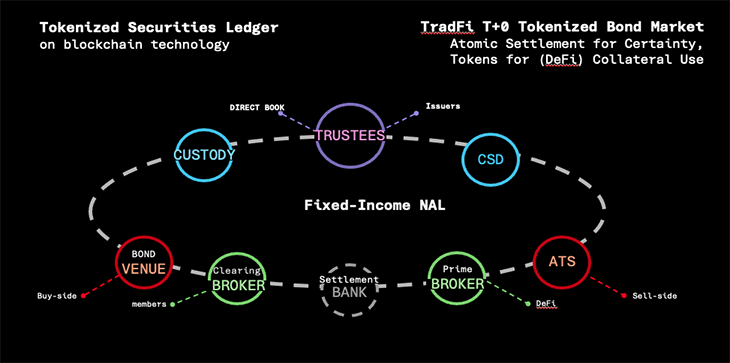
Tokenized fixed-income markets will emerge from the same participants who already define the lifecycle of a bond. The participants in that ecosystem are:
Prime Broker: leverages it
Bond Venue and ATS: trade it
Clearing Broker: nets obligations
Settlement Bank: settles cash
Underwriters: fund the issuance
Issuer + Trustee: originate the liability
DirectBooks: records allocation
The Fixed-Income Network Accounting Ledger (NAL) provides a shared real-time accounting substrate and settlement layer that synchronizes accounting record between all participants and their respective systems.
Issuance:
1. DirectBooks coordinates allocation between issuers and underwriters. This event establishes:
- face amount
- cost basis
- entitlement schedule
- lifecycle anchor
- underwriting short
- investor beneficial ownership
2. Trustees begin contract recordkeeping in their trust accounting systems.
3. CSD records the position in its registry.
4. Custody onboards the position into safekeeping.
When DirectBooks and the Trustee participate on the NAL, allocation events can mint tokenized bonds with synchronized lifecycle data.
5. Secondary onboarding:
Custody and the Trustee can be triggered by Broker messaging to:
- reconcile the dematerialized position
- mint a token via the mint/burn gateway
- anchor the token to the trustee’s contract record
- synchronize cost basis, accrual state, and chain-of-title
This brings existing inventory into the tokenized lifecycle with authoritative data from the source.
6. Trading:
A Bond Venue or ATS reads synchronized inventory from the NAL and:
- hosts order books
- discovers liquidity
- matches trades
- publishes execution events
7. Clearing Brokers managing retail or institutional accounts connect to the Bond Venue & ATS through API workflows. They support client execution and manage the full obligation lifecycle between trade and settlement.
Operational workflows include:
- OMS order routing — sending client orders to the Bond Venue & ATS
- API trade execution — receiving matched trades and execution reports
- Obligation management — establishing trade obligations and contractual details
- Risk and exposure management — applying margin, collateral, and exposure controls
- Settlement instruction generation — preparing and transmitting settlement instructions to the settlement bank
8. Settlement Banks complete cash settlement. The NAL updates all nodes atomically.
9. Financing:
A Prime Broker on the NAL can:
- receive tokenized bonds via the mint/burn gateway
- link authoritative chain-of-title into a DeFi wrapper
- lend tokens as yield-bearing collateral
- issue financing against synchronized positions
- circulate tokens as tradable artifacts
All lifecycle data remains synchronized through the NAL.